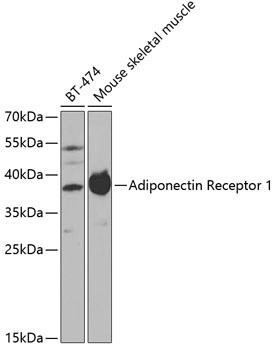
Polyclonal antibody against adiponectin receptor 1 (ADIPOR1).
Target: adiponectin receptor 1 (ADIPOR1)
Clonality: Polyclonal
Reactivity: Human
Proven applications: WB, IHC, IF / ICC, IP
Host: rabbit
Recommended dilutions
WB: 0.5-2 µg / ml, IHC: 5-20 µg / ml, IF / ICC: 5-20 µg / ml. The end user must determine the optimal dilutions / concentrations.
Conjugation: in conjugated
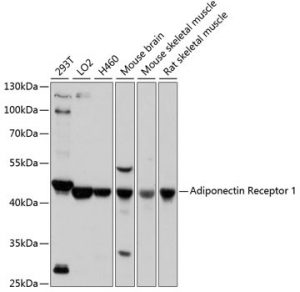
Immunogen: Recombinant abx065171 – ADIPOR1 (Met1-Gly136) expressed in E. coli
Form: Liquid
Purification: Purified by antigen-specific affinity chromatography, followed by protein A affinity chromatography.
Storage: Aliquot and store at -20 ° C. Avoid repeated freeze/thaw cycles.
UniProt Primary AC: Q96A54 (UniProt, ExPASy)
Secondary UniProt AC: B3KMB0, Q53HS7, Q53YY6, Q9Y360
UniProt input name: PAQR1_HUMAN
KEGG has: 51094
Rope: 9606.ENSP00000341785
Buffer: 0.01 M PBS, pH 7.4, containing 0.05% Proclin-300, 50% glycerol.
Availability: Shipped within 5 to 12 business days.
Note: This product is for research only.
Adiponectin receptor 1 antibody (PA1-059) in WB
Western blot analysis of Adiponectin Receptor 1 was performed by loading 25 µg of rat skeletal muscle (lane 1), human skeletal muscle (lane 2), and HepG2 (lane 3) lysates on an SDS polyacrylamide gel. The proteins were transferred to a PVDF membrane and blocked at 4 ° C overnight. The membrane was probed with a polyclonal adiponectin receptor 1 antibody (product # PA1-059) at a dilution of 1: 500 overnight at 4 °
Destination information
Adiponectin (also known as the 30 kDa adipocyte complement-related protein; Acrp30) is a hormone secreted by adipocytes that acts as an antidiabetic and antiatherogenic adipokine. Adiponectin levels in the blood decrease in conditions of obesity, insulin resistance, and type 2 diabetes. Adiponectin administration produces hypoglycemic effects and improves insulin resistance in mice. In contrast, adiponectin-deficient mice exhibit insulin resistance and diabetes.
This insulin-sensitizing effect of adiponectin appears to be mediated by an increase in fatty acid oxidation through the activation of AMP kinase and PPAR-. Here we present the cloning of complementary DNAs encoding adiponectin receptors 1 and 2 (AdipoR1 and AdipoR2) by expression cloning. AdipoR1 is abundantly expressed in skeletal muscle, while AdipoR2 is predominantly expressed in the liver.
These two adiponectin receptors are predicted to contain seven transmembrane domains but are structurally and functionally distinct from G protein-coupled receptors. Expression of AdipoR1 / R2 or suppression of AdipoR1 / R2 expression by RNA of little interference supports our conclusion that they serve as receptors for globular and full-length adiponectin, and that they mediate increased AMP kinase and PPAR ligand activities, as well as fat-acid oxidation and glucose uptake by adiponectin.